
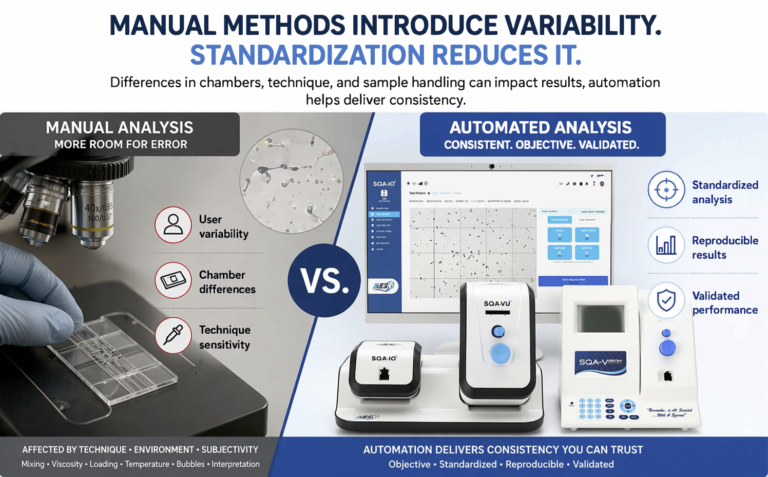
Difference in Counting Chambers
Labs that choose to validate their SQA Sperm Quality Analyzer against an existing microscopic method may use a
variety of counting chambers. Common options include the Makler Chamber, disposable counting chambers (such
as Leja slides, Incyto C-Chip, MicroCell, or similar), or an improved Neubauer chamber (hemocytometer).
The Makler Chamber and various disposable counting chambers are commonly used, as they do not require sample
dilution prior to loading, and may be easier to operate than Neubauer chambers in routine practice.
What Does the WHO Say?
The WHO Laboratory Manual for the Examination and Processing of Human Semen has long served as the global
reference standard for semen analysis methodologies. With each revision, the WHO refines its guidance to reflect
current scientific understanding and best laboratory practices. The 6th Edition, published in 2021, continues to guide
both MES and laboratories worldwide. https://www.who.int/publications/i/item/9789240030787
Consistent with previous editions, the WHO identifies the hemocytometer, specifically the improved Neubauer
chamber, as the reference method for sperm concentration assessment, citing its accuracy, reproducibility, and
methodological consistency when performed correctly:
2.4.8.2 The haemocytometer with improved Neubauer ruling is recommended. Dilution factors for the improved
Neubauer haemocytometer chamber are given in Section 2.4.4.3 on page 20. Other haemocytometer chambers
may be used, but if they have different grid patterns and areas, other calculation factors are required. Disposable
haemocytometers with Neubauer ruling must be validated.
The WHO 6th Edition goes on to state the following as it pertains counting chambers for sperm concentration, in
section 2.5.8”
“Disposable chambers are available for determining sperm concentration (86, 138-141), but they may produce
different results from those of the improved Neubauer haemocytometer.”
Study 86 (Kirkman-Brown and Bjorndahl) is clear in its conclusion: “The plastic disposable chamber type was not
suitable for routine semen analysis because results are variable depending on the microscope used, and increased
time is necessary to do the assessment accurately.”
Study 138 (Seaman et al.) also states in its conclusion: “Our data revealed marked differences in the accuracy and
reliability of the different counting chambers tested and emphasized the need for standardization and quality control
of laboratory procedures.”
Additional Studies
Indeed, additional studies state that depths of sperm counting chambers must be verified regularly. This is
especially pronounced on Makler Chambers, where erosion and wear from long term use can greatly impact
accuracy: https://pmc.ncbi.nlm.nih.gov/articles/PMC4793174/.
Makler Chambers
The Makler chamber is commonly used as a reusable, straightforward counting chamber that requires only 10 µL of
undiluted sample. While simple to use, it has known limitations. A published study demonstrated that even a brief
delay in placing the cover glass can significantly impact measured sperm concentration:
https://www.fertstert.org/article/S0015-0282%2899%2900623-8/fulltext.The same study emphasizes the need to confirm color fringes at all four contact points to ensure proper chamber
depth and sample thickness. The WHO addresses this directly in Section 2.4.8.3 (item 7), noting that proper
sedimentation in a Neubauer chamber must be controlled:
“Store the haemocytometer horizontally for at least 10–15 minutes (to allow complete sedimentation of spermatozoa
in the 100 μm deep chamber) at room temperature in a humid chamber (e.g., on water-saturated filter paper in a
covered Petri dish) to prevent drying.”
This step is fundamental to achieving consistent results and is not accounted for in Makler or other disposable
chambers. Additional studies (Christensen et al.) have shown that Makler chambers are subject to low precision,
with duplicate counts recommended to improve reliability:
https://www.sciencedirect.com/science/article/abs/pii/S0093691X04001852).
“It thus appears that the poor precision of the Makler chamber also affects the accuracy… duplicate counts by at
least two technicians are recommended.”
More broadly, common sources of error with the Makler chamber include chamber wear over time, user variability,
and inconsistent cleaning practices.
How Was the SQA Validated?
The SQA-iO, SQA-Vision, and SQA-V Gold have all been extensively validated compared to the WHO “Gold
Standard”: The Improved Neubauer Hemocytometer:
https://mes-global.com/support/medical-electronic-systems-studies-and-publications/.
Additional Variables
Discrepancies are often driven by technique and environment even before the sample is counted. Common factors
include inadequate sample mixing, high viscosity, improper chamber loading, temperature variation, bubbles,
biological variability, and operator subjectivity.
Summary
Labs validating SQA systems against manual microscopy may use a range of counting chambers, including Makler,
disposable slides, or the improved Neubauer hemocytometer. While Makler and disposable chambers are often
preferred for convenience and ease of use, the WHO 6th Edition continues to define the improved Neubauer as the
reference standard due to its accuracy, reproducibility, and controlled methodology. The WHO and multiple studies
note that alternative chambers can produce variable results and require validation, with specific concerns around
precision, chamber depth, and technique sensitivity.
Makler chambers, in particular, are susceptible to variability from cover glass placement, chamber wear, and user
technique, and do not account for controlled sedimentation, a key step in Neubauer-based methods. The SQA
systems have been validated against the Neubauer standard, and differences observed in comparison studies are
often driven less by the device and more by variability in manual methods, sample handling, and technique.