From Fertility Test to Vital Sign: How Semen Analysis Became a Window Into Men’s Health
A semen analysis is one of the few health metrics a man can actually move, and watch move, within a single season. That makes it an unusually powerful prompt for lifestyle change.
For most of its history, the semen analysis was a single-purpose lab test, ordered when a couple struggled to conceive and rarely thought about otherwise. But a quieter and arguably more useful application is emerging: the semen analysis as a feedback instrument for men who want to improve their health and need a concrete, measurable signal that their efforts are working.
What makes the test unusual is its responsiveness. A cholesterol panel drifts over years. Body weight moves, but slowly and noisily. Blood pressure fluctuates by the hour. Semen parameters, by contrast, reflect a biological process with a fixed and relatively short clock, which means a man can change his behavior, wait one cycle, re-test, and see whether the needle actually moved. Few other health metrics offer that kind of closed loop, and it is the loop, more than the numbers themselves, that makes semen analysis worth paying attention to.
A 90-day feedback loop
Spermatogenesis, the production of mature sperm from precursor stem cells, takes roughly 70 to 75 days within the testes, followed by a further 10 to 14 days of transit and maturation in the epididymis, for a total of about three months from start to finish [1]. That timeline has a practical consequence that is easy to miss: the sperm in any given sample are the product of the body’s hormonal, metabolic, and environmental conditions of roughly 90 days earlier. A semen analysis is, in effect, a report card on the previous quarter.
For a man trying to improve his health, that is unusually convenient. It means a sample collected today reflects the last three months of habits, and a sample collected 90 days after a deliberate change in diet, activity, weight, or exposures, captures the effect of that change with reasonable cleanliness. Fertility clinicians already use this interval as a matter of routine: a baseline analysis, a defined intervention, and a re-test one full cycle later. The same structure works just as well when the goal is general health rather than conception. The man is not waiting on a distant, abstract payoff; he is running a controlled experiment on himself with a three-month read-out.
What actually moves the needle
The evidence that lifestyle change improves semen quality is now reasonably strong, and importantly, several of the best studies are randomized controlled trials rather than observational associations, which makes the relationships harder to dismiss as confounding.
Weight is the clearest lever. In a randomized controlled trial published in Human Reproduction, men with obesity completed an eight-week low-calorie diet and lost an average of 16.5 kilograms. Sperm concentration rose roughly 1.5-fold and total sperm count roughly 1.4-fold over those eight weeks, improvements of about 50% and 40%, respectively. Those gains were sustained at the one-year mark in the men who kept the weight off, but were lost entirely in the men who regained the weight [2]. The bidirectionality is the encouraging part: obesity suppresses spermatogenesis through aromatase-driven conversion of testosterone to estrogen, chronic low-grade inflammation, and elevated scrotal temperature, and each of those mechanisms is at least partly reversible on a timescale of months.
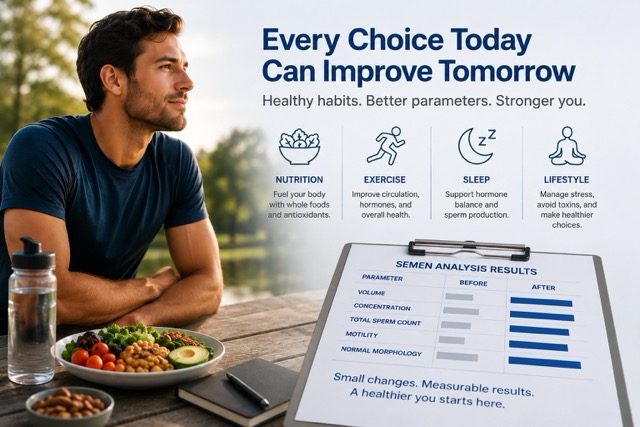
Diet exerts an effect that is partly independent of weight. A randomized controlled trial of 160 healthy young men assigned to either a Mediterranean diet or a low-fat diet found higher sperm concentration and total count in the Mediterranean-diet group [3]. The FASt trial went further, enrolling 263 healthy young men living in highly polluted areas of Italy and randomizing them to a four-month program of Mediterranean-diet adherence plus moderate physical activity; sperm concentration, motility, and the proportion of normally shaped cells all rose in the intervention group and fell in the controls, alongside a measurable increase in the antioxidant capacity of seminal fluid [4]. The proposed mechanism is consistent across these studies, a diet rich in vegetables, fruit, and polyphenols lowers the oxidative stress that damages sperm membranes and fragments sperm DNA — and it is the same mechanism implicated in vascular and metabolic disease.
Other exposures are individually smaller, but they are real, well documented, and the recurring theme, modifiable. Smoking raises sperm DNA fragmentation and is associated with lower counts; cessation generally helps, though the reversibility is less reliable than it is for weight [5]. Heavier alcohol consumption is associated with lower sperm count [6]. Scrotal heat from occupational exposure, hours of uninterrupted sitting, laptops, or frequent hot baths and saunas — depresses sperm concentration and DNA integrity, and because of the 90-day cycle it is also one of the faster-reversing variables [7]. Sleep and circadian disruption affect testosterone secretion and, indirectly, sperm output. No single one of these is dramatic in isolation. But they are all things a man can change, and the semen analysis is the instrument that tells him, quarter by quarter, whether the changes are landing.
What’s good for sperm is good for the rest of you
There is a second reason this matters, and it is worth touching on rather than dwelling on. The exposures that degrade semen quality, visceral fat, insulin resistance, oxidative stress, smoking, a poor diet are the same well-established drivers of cardiovascular disease, type 2 diabetes, and several cancers. So, the changes that improve a semen analysis are not narrowly reproductive interventions. They are, almost exactly, the interventions a cardiologist or an endocrinologist would prescribe anyway.
That overlap is increasingly well documented. Large cohort studies have found that men with better semen quality tend to live longer and develop fewer chronic diseases: a 2025 study in Human Reproduction that followed 78,284 men reported that those with the highest motile sperm counts could expect to live roughly two to three years longer than those with the lowest [8]. Reviews in journals including Nature Reviews Urology and the Journal of Clinical Medicine now describe the semen analysis as a proxy for systemic male health rather than a fertility-only test [9][10]. For the purposes of a man using the test as a feedback tool, the practical reading of that literature is reassuring rather than alarming: a semen analysis that improves after three months of better habits is plausibly a sign that cardiometabolic risk is drifting in the same favorable direction. The sperm count is the visible dial; the broader health benefit is the larger machine it is attached to.
Putting it to use
For a man who wants to use semen analysis this way, the structure is simple. Establish a baseline, ideally with a clinical-grade or CLIA-certified laboratory analysis rather than a count-only screening device, because motility and morphology carry much of the useful signal and are difficult to measure accurately outside a trained lab [11]. Make a defined, written set of changes: weight, diet, physical activity, smoking, alcohol, heat exposure, sleep. Then re-test after at least one full 90-day cycle. Testing sooner mostly measures the previous quarter and invites false discouragement.
A new generation of at-home collection kits like our YO Home Sperm Test has made the logistics of baseline-and-retest considerably easier, removing the clinic visit that many men quietly avoid; their accuracy varies by product, and they are best treated as longitudinal tracking tools rather than diagnostic substitutes. Two caveats are worth keeping in view regardless of where the sample is analyzed. First, semen parameters are biologically noisy from one sample to the next, so a single borderline result should not be over-interpreted — a trend across two or three analyses is far more trustworthy than any one number. Second, a semen analysis is not a diagnostic test for any specific disease, and it should not be read as one.
The case for a responsive metric
What the semen analysis offers is something more modest, and for many men more motivating, than a diagnosis. It is a number that genuinely responds on the timescale of a single season to the choices a man makes about how he eats, moves, sleeps, and exposes his body. Preventive medicine has a well-known engagement problem: the rewards of good behavior are usually invisible and decades away, which is a poor match for human motivation. A metric that visibly improves within three months, and that happens to track the same biology as heart disease and diabetes, is an unusually good answer to that problem. The semen analysis was never just a fertility test. Used deliberately, it is a short-feedback-loop vital sign, and a quietly effective reason to change.
References
- Histology, Spermatogenesis. StatPearls, National Library of Medicine. https://www.ncbi.nlm.nih.gov/books/NBK553142/
- Andersen E, Juhl CR, Kjøller ET, et al. Sperm count is increased by diet-induced weight loss and maintained by exercise or GLP-1 analogue treatment: a randomized controlled trial. Human Reproduction. 2022;37(7):1414–1422. https://academic.oup.com/humrep/article/37/7/1414/6587152
- Montano L, Ceretti E, Donato F, et al. Effects of Mediterranean diet on semen parameters in healthy young adults: a randomized controlled trial. 2021. https://pubmed.ncbi.nlm.nih.gov/33478205/
- Montano L, Ceretti E, Donato F, et al. Effects of a lifestyle change intervention on semen quality in healthy young men living in highly polluted areas in Italy: the FASt randomized controlled trial. 2022. https://pubmed.ncbi.nlm.nih.gov/33579652/
- Can lifestyle changes significantly improve male fertility: a narrative review. World Journal of Men’s Health / Arab Journal of Urology. 2024. https://www.tandfonline.com/doi/full/10.1080/20905998.2024.2421626
- Effects of alcohol use on sperm chromatin structure: a retrospective analysis. 2023. https://pmc.ncbi.nlm.nih.gov/articles/PMC10249235/
- McKinnon CJ, Hatch EE, Rothman KJ, et al. Male personal heat exposures and fecundability: a preconception cohort study. Andrology. 2022. https://pmc.ncbi.nlm.nih.gov/articles/PMC9588744/
- Priskorn L, Lindahl-Jacobsen R, Jensen TK, et al. Semen quality and lifespan: a study of 78,284 men followed for up to 50 years. Human Reproduction. 2025;40(4):730–740. https://academic.oup.com/humrep/article/40/4/730/8051460
- Salonia A, et al. Unlocking the power of semen analysis in primary health care — a path to men’s health and lifestyle transformation. Nature Reviews Urology. 2025. https://www.nature.com/articles/s41585-025-01047-1
- Pozzi E, Ramasamy R, Salonia A, et al. Male fertility as a proxy for health. Journal of Clinical Medicine. 2024;13(18):5559. https://pmc.ncbi.nlm.nih.gov/articles/PMC11432267/
- Yu J, Long H, Wang Z, et al. Clinical update on home testing for male fertility. World Journal of Men’s Health. 2021. https://pmc.ncbi.nlm.nih.gov/articles/PMC8443999/